
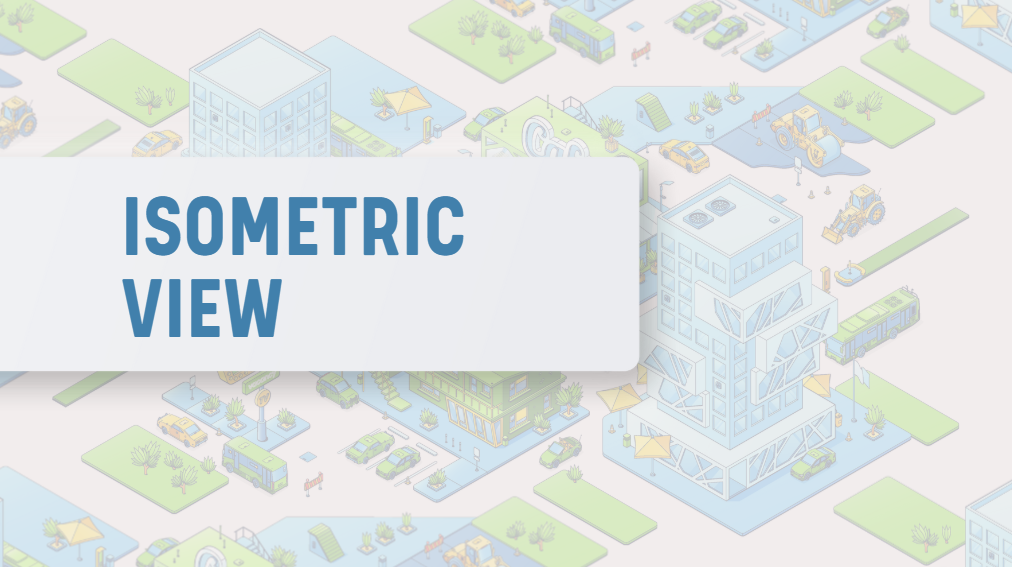
What Is an Isometric View?
An isometric view is a way of drawing or showing a 3-dimensional object on a flat surface like paper or a screen. Instead of showing just one face, an isometric shows three sides of the object at the same time so you can see the shape clearly.
ALSO READ : iPhone PNG
This kind of view does not use perspective. That means objects do not look smaller when they are far away. All parts stay the same size and look balanced.
The word “isometric” comes from Greek and means “equal measure.” This name is used because the lengths along all three directions are shown in equal scale.
Easy Explanation of Isometric
Imagine you have a box in front of you. If you look at only the front, you see only one side. But in isometric, you turn the box so you see the front, side, and top all at once. This makes it easier to understand the whole shape.
Most isometric views show the object with three directions (axes) that meet at 120° angles. These equal angles help the picture look correct even though it is on a flat surface.
In simple words:
- You see many sides at once.
- Nothing looks smaller just because it is far away.
- The picture is balanced, not realistic like a photo.
Isometric View vs. Perspective View
It helps to compare isometric view with perspective view:
Isometric View
- Shows three sides of an object.
- Lines stay parallel and do not meet at a point.
- Objects keep the same size no matter where they are placed.
- Easy to measure lengths in the drawing.
Perspective View
- Looks more like real life.
- Lines go toward a vanishing point (a point where lines look like they meet).
- Objects get smaller as they go farther away.
- Harder to measure real size from the picture.
Because of these differences, isometric view is used more for drawing machines, buildings, games, and technical things where correct size and shape are important.
Where Isometric Views Are Used
Isometric view is not only for school or drawing books. It is used in many real-world places:
1. Engineering and Technical Drawing
Engineers use isometric views to show a part clearly so someone can build it. The drawing keeps the shape and makes measurements easier.
2. Architecture
Architects use isometric views to show buildings and rooms so others can see how they fit together.
3. Video Games
Many games use isometric style to show a world from a 3-D angle while still using simple graphics. This view helps players understand movement and space.
4. Product Design
When designers show how a product works or fits together, an isometric view lets people see many sides of the object at once.
How Isometric Drawings Are Made
Making an isometric view is not very hard if you follow some simple steps:
- Start with a 3-axis grid—one vertical line and two lines at an angle (usually 30° from the horizontal).
- Draw vertical lines up for the height of the object.
- Draw angled lines for depth and width along the grid.
- Connect all lines to make the 3D look.
This method helps keep all parts in scale and balanced.
Advantages of Isometric View
There are many reasons why people choose an isometric view:
Easy to understand—you can see three sides at once.
Accurate measurements—You can measure length, width, and height directly.
Simple drawing rules—the drawing stays clean and clear.
Useful for instructions—helps people build or assemble things easily.
Limitations of Isometric View
Even though isometric view is helpful, it also has some limits:
Not realistic like photos—it does not show how things truly look to the eye.
Can be confusing for very complex shapes—too many lines may overlap and look messy.
Does not show true angles—some angles in the object may look different than reality.
Tips for Beginners
If you are new to isometric view:
✔ Use grid paper with triangles—it makes drawing easier.
✔ Practice with simple shapes first—start with boxes or cubes.
✔ Use rulers and set squares—they help keep lines accurate.
✔ Look at examples online or in books—seeing many drawings helps you learn fast.
FAQs
1. What does “isometric” mean?
“Isometric” means equal measurement. It refers to showing an object so all three sides are drawn in equal scale.
2. Why don’t isometric drawings use perspective?
Because isometric views show objects with parallel lines and no vanishing points, they do not use perspective like realistic pictures do.
3. Can you measure objects in isometric view?
Yes! One big benefit is that you can measure length, width, and height directly on the drawing.
4. Is isometric view used in video games?
Yes, many games use this view to give a 3D look while keeping graphics simple.
5. Is isometric view hard to learn?
No—with simple steps and practice, anyone can learn it. Start with simple shapes and move to bigger ones.